Showing posts with label robots. Show all posts

Can ElliQ the robot combat social isolation in the elderly?

When you think of robots designed to help people, you might think of the role of robotics in caring and customer service roles or companion orientated service robots like Pepper, Nao or even Hasbro’s companion pets. Then more recently there’s the emergence of robots as sexual or romantic partners. One start-up from Israel, Intuition Robotics is throwing an interesting offering into the ring, a new AI companion called ElliQ, aimed at keeping older adults active and engaged, and reducing the epidemic of loneliness among older people. I spoke with Dor Skuler, CEO and co-founder to find out more.


Skuler explained the rationale behind the robot:


“We live longer but also healthier lives. 90 percent of older adults want to live in their own home and the period of time we’re still cognitive, still independent and we don’t have to live in assisted care is growing. Conversely, younger people live further, and further away from their parents with hectic lifestyles that rely heavily on technology. About 30 to 60 percent of older adults identify themselves say that they are lonely which usually means that the real number is even higher.”


In terms of function, ElliQ is perhaps closer to Alexa than Pepper as Intuition Robotics is leveraging Cognitive Computing, Human Robotics Interaction, and Cloud Robotics in developing the robot’s ability to proactively recommend digital and physical activities to keep owners active and engaged with family, friends, and life.


The robot creates a conduit for older adults to connect with their family. As Skulker notes:


“What we can do with robots is really simplify the means for older adults to connect with their family. If you look at a typical family, we’re all on Facebook Messenger. We share some of the information and pictures and content but aging parents are not part of that discussion. Teenagers don’t want to call grandparents. But what they love to do is share a selfie, to find the link to a TED talk. They maybe send an emoji or text message and communicate the way they’re used to communicate but just on messenger. So the first thing that we created is in essence, a virtual chat bot for a messenger that allows the family to very easily connect with Grandma.


But it’s extremely intuitive. They don’t have to work the text, they don’t have to unlock their phone. They don’t need to try and look at small letters, they don’t need to click anything with their fingers. We just tell them ‘hey here’s a new picture from your granddaughter do you want to see?’  If she says yes we can show it to her and if she wants to comment then we record a message and it’s sent. So all of a sudden she’s part of the conversation. She gets the opportunity to get the content instead of having that once a week awkward discussion, she’s just part of the family.”


See also: Are robots replacing humans in health care?


It’s a bit like putting older relatives back in the family home where they are content to sit and observe and engage with the family members as they go about their day. ElliQ also takes this a step further with a proactiveness that differentiates the robot from Alexa and Siri that wait for the user to prompt them:


“Older adults by and large become reactive and not proactive. they tend to stick to a routine. They tend not to discover and add new things and new capabilities to their day. If you suggest things to them that are relevant to them there’s a very high probability that they’ll say yes. (Which by the way means you have to be extremely responsible and only suggest appropriate things and never take advantage). So basically ElliQ has extremely smart sensors and the ability to understand what’s going on at home and suggest activities. For example, ‘ Hey, it’s a beautiful day why don’t you go for a walk?’. It might be a schedule reminder to take your meds, a reminder to keep an appointment and it might be in the digital world: ‘Hey you want to listen to some Frank Sinatra? Or here’s a great TED talk you might want to listen to?’”


A unique aesthetic


ElliQ’s innovative design was created in collaboration with Yves Béhar, founder and principal designer of the award-winning industrial design firm fuseproject. It is comprised of two separate elements: ElliQ, the social director, exhibits human characteristics through gestures animated by movement, speech, sounds and light. A LED lighting display, along with a wide range of motions are utilized to convey subtle emotional expressions and give the device a friendly and warm personification. The second element consists of a separate screen that functions in a cradle display or in the user’s hand to view content in the location of their choice.


It’s not every day that you speak to a CEO of a start-up whose first hire was a gerontologist.  Other involved with the project include former VP of Advanced Technologies at Apple, Prof. Don Norman, along with Intel SVP Amir Faintuch, and leading academic experts in the fields of Cognitive Computing, HRI, Machine Intelligence, and Robotics.


Skuler explained that some of their initial assumptions of a robot for the aged were incorrect:


“We thought that we each create an environment in which the older adult needs to take care of ElliQ and we found out that that’s not really the case. The best thing you can do is help people feel like they’re not completely alone at home.  We were worried that older adults wouldn’t want to talk to a machine. Especially when I sat in a room full of older adults and showed them how I use Siri. and I got very strange looks. But we found they are absolutely willing to talk to a machine and over time they treat them more and more as entities rather than devices.” 


ElliQ is currently being showcased at the Design Museum in London and in February Intuition Robotics will be rolling out a trial phase in the homes of older adults in the San Francisco Bay Area.

Chirp provides soundwave communication to the Internet of Things

It’s not every day that you meet a startup with showcasing technology that sounds like something of out of the Cold War. Like the use of sound waves to transmit data from one device to another, eschewing the need for QR codes, Wi-Fi, Bluetooth or NFC. But this exists thanks to the work of the team at Chirp, a group of scientists, acoustic technologists, and engineers that emanated out of University College London.


A Chirp is a sonic barcode. Data and content can be encoded into a unique audio stream. Any device with a speaker can transmit a chirp and most devices with a microphone can decode them. I spoke to CEO Moran Lerner to find out more.


Lerner explained:


“Chirp was born out of extensive research, through which we saw a series of pain points across several sectors that could be solved. it is old technology that we have reinvigorated to help new technologies. Data is encoded into a series of pitches and tones on the sending device and decoded on the receiving device. We refer to this method of transmitting data-over-sound as asmodulation/demodulation. These pitches and tones can be either ultrasonic, or audible where ultrasonic frequencies are unable to work, such as in radio broadcasting, or where the hardware is not capable of transmitting ultrasonic frequencies.”


[embedded content]

Chirp can also extend an existing network infrastructure by creating data-over-audio links between individual devices and a network that is safe to use even in RFD-restricted environments, enabling the connection of the 90% of devices in the world that wouldn’t normally be part of an IoT ecosystem with the 10% of devices that would. This means offer almost unlimited problem-solving possibilities across all sectors, including telecommunications, financial services, IoT, entertainment and broadcasting, interactive gaming, toys, robotics, transportation and many others. Their technology is used by leading brands in more than 90 countries.


For industrial solutions…


Some of the most innovative applications by Chirp are within industrial environments. As Lerner explained:


“We have clients in nuclear energy where radio frequencies are restricted and regulated in a nuclear power plant. By law, you’re not allowed to have any wifi, bluetooth or NFC and so our technology enables them to become smart factories by putting speakers and microphones into those old legacy buildings. If you walk around a tablet in airplane more and start simply getting all that data in real time instantly which actually ends up saving around a billion pounds a day in operations.”


In such environment, organizations can use Chirp, in order to enable personnel location tracking, access and authentication and data reporting from equipment within the facility. This also works in industries where they are working with chemicals and potentially explosive devices and materials in mining, agriculture, and pharmaceuticals.


…and other solutions


Other applications include Shuttl in India for their ticketing and bus transportation solution, global leader Amdocs for their telecommunications mobile wallet and MNO solutions, and Activision Blizzard for their latest instalment of their $3 billion Skylanders franchise – Skylanders Imaginators, using Chirp to share characters from the game directly to the companion app through sound – bypassing the console and completely offline.
[embedded content]

Chirp recently announced a partnership with Unified Inbox to quickly onboard devices onto their platform. The partnership will allow fast, easy, and secure onboarding of residential, commercial, and government IoT devices. UIB provides natural language communications (NLP) for IoT devices. People can communicate with their devices through the communications channels they already use, simplifying the onboarding process. The Chirp + Unification Engine integration layer can be easily adapted and developed for smart home, smart enterprise, and smart city use cases across verticals including energy, public transit, healthcare, waste/water management, home appliances, and consumer electronics.


The challenges of niche technology


Chirp is part of a growing abundance of IoT-related technology that is emerging from University academia in niches that are highly specialized, researched and studied. As Lerner explains:


“It’s a very, very difficult science to master and what puts us so far ahead is our academic strength, that our work is researched by some of the leading academics on the field. One of the problems we are tackling ourselves is the ethics of how you take a solution to market. We’re not trying to be market leaders by marketing our technology as anything more than what it can actually do. We don’t exaggerate what it can do.


See also: Mumbai slums uses beacons for retails sales


We are very open and honest about what it can’t do. But one of the biggest issues affecting the tech sector over the last 5 years with the boom of IoT is that you get a lot of companies coming out to raise a lot of capital and the exaggeration of what they claim the technology can do is mind-blowing, So we’ve got a competitor who makes claims about their ultrasonic technology that breaks every known law of physics. We try to keep away from companies like that. But the reason we’re vocal about it and we try to do things with integrity and authenticity is that a company like that doesn’t just affect us. It affects the industry and erodes the trust in the industry.


So many companies are moving towards academia because when you bring in a team of scientists and academics technologists, they are just born to be honest, and to work within the boundaries of what science allows. It’s not just bringing in people because they can add credibility, it’s the way they develop the technology is based on real science.


It means that when you present it to some venture capitalists they might not like what you say, it might not do what want it to do, but at least you are going to market with something that s not actually going to meet and solve real problems rather than promise to deliver and fail, but that was something that actually needs to. A promise to deliver. ”


We have experienced exponential growth in technology over the last decade, coming to a position of solution-focused technology such as Chirp. It’ll be interested to witness their growth in use cases.

"Reverse Prisma" AI turns Monet paintings into photos

Style transfer has suddenly become a hot thing, apparently, as Adobe recently showed off an experimental app that lets you apply one photo style (’90s stoner landscapes) to another (your crappy smartphone photo).


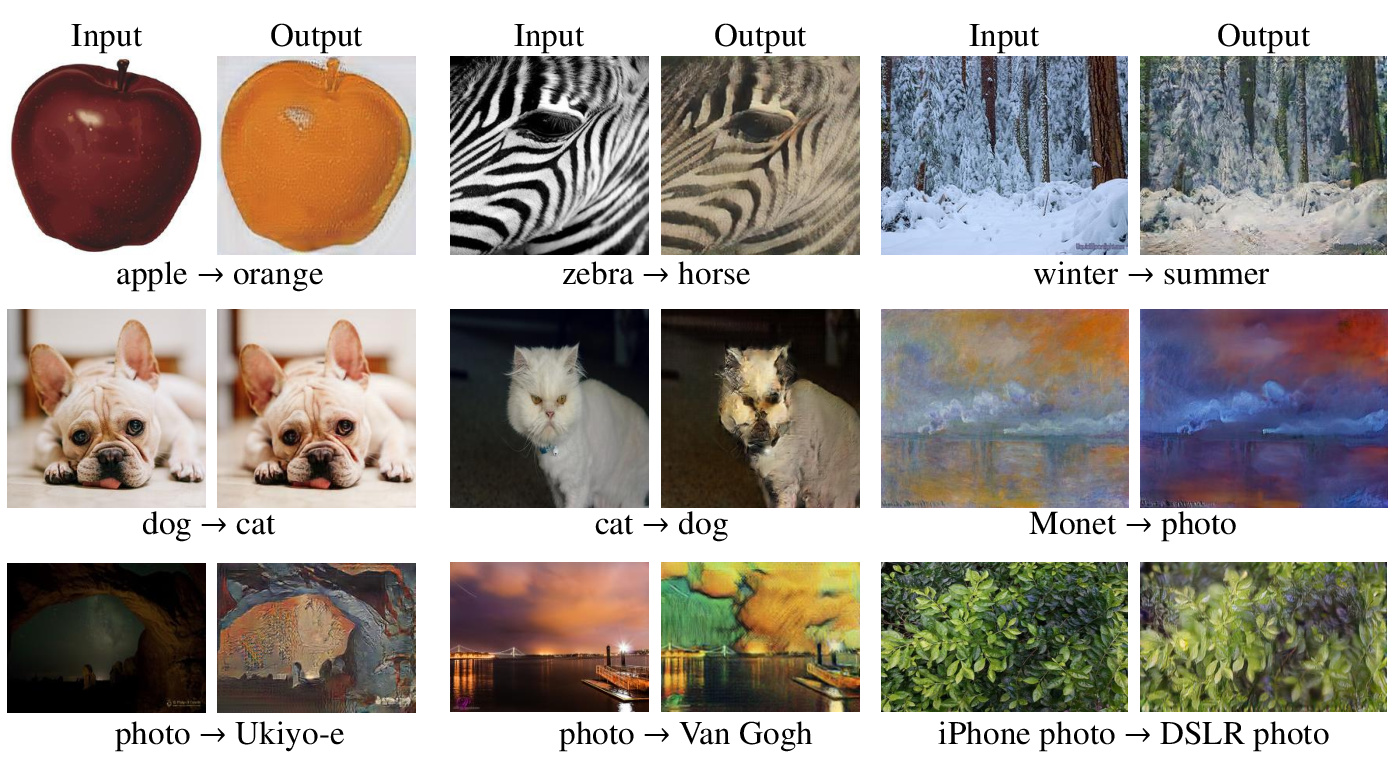
UC Berkely researchers have taken that idea in another direction. You can take, for instance, a regular photo and transform it into a Monet, Van Gogh, Cezanne or Ukiyo-e painting. The team was also able to use the technique to change winter Yosemite photos into summer ones, apples into (really weird) oranges and even horses into zebras. The technique also allowed them to do photo tricks like creating a shallow depth of field behind flowers and other objects.


The most interesting aspect of the research is the fact that the team used what’s called “unpaired data.” In other words, they don’t have a photo taken at the scene at the exact moment Monet did his painting. “Instead, we have knowledge of the set of Monet paintings of of the set of landscape photographs. We can reason about the stylistic differences between those two sets, and thereby imagine what a scene might look like if we were to translate it from one set into another.”


That’s easier said than done though. First, they needed to figure out the relationships between similar styles in a way that a machine can understand. Then they trained so-called “adversarial networks” using a large number of photos (from Flickr and other sources) and refined them by having both people and machines check the quality of the results.


Ideally, the system would be “cycle consistent.” Just as you hope to have the original sentence when you translate English to French and back again, you want roughly the same painting when you translate a Monet to a photo and back again. In many cases, other than a loss of pixel resolution, the team succeeded in that regard (above).


All is not perfect, of course. Since the algorithms have to deal with a lot of different styles for both paintings and photos, they often fail completely to transfer one to another. As with other systems, one of the main issues is with geometric transformations — changing an apple into an orange is one thing, but attempting to transform a cat into a dog instead produces a very disturbing cat.


The team adds that its methods still aren’t as good as using paired training data either — ie, photos that exactly match paintings. Nevertheless, left on its own accord, the AI is surprisingly good at transferring one image style to another, so you’ll no doubt see the results of their work soon in your Instagram feed. If you want to try it for yourself and are comfortable with Linux, you can grab the code here.

Scientists control soft robots with magnetic fields

The scientists used their fresh approach to build three robots that take advantage of this newfound flexibility. One is a cantilever (the “lifter” you see above) that can carry up to 50 times its weight. An accordion bot can expand and contract like a muscle, while a valve can squeeze to act as a pump.


There’s no question that it’ll take a long time to make this method viable for real robots. You’d need an external device to produce the field, for a start. However, the potential uses are already easy to see. The accordion and valve robots would be particularly useful for robots that have to mimic organic functions, not to mention prosthetics, implants and other health care equipment.

Flying courier drone can drive up to your door

The Panther drone isn’t a heavy-duty hauler when it can only carry 15lbs, and its range is limited to 10 miles when on the ground (flying range isn’t mentioned, but it only flies for 5-10 minutes). However, it can handle attachment that extend its usefulness well beyond getting products from A to B. You can add a camera and video screen for telepresence, or sensors if you’re using it to study nature or construction projects. You can even add robot arms to grab samples or unload supplies.


The Panther is already on sale in the US (it’s discounted to $2,495 until April 5th), and Advanced Tactics is quick to stress that you don’t need to go through regulatory hoops to own one. It’s light enough to be considered a small drone, so you don’t need an FAA waiver to fly it. You probably won’t see companies using it right away, though. While it’s relatively easy to buy a drone for personal use, it’s another matter to clear the legal and logistical hurdles needed to use it for business. Where would delivery drones launch from, for example? Still, the test is proof that there are already drones that can solve some of the real-world problems with drone use.