Showing posts with label Twitter. Show all posts

Customer service on Twitter now includes location sharing

Imagine sending a direct message to your carrier when you have a problem with your phone. The brand manager will get your permission to receive your location data and then they can direct you to the closest store. This could make getting your needs met much faster than searching around your mapping app or Yelp.


Twitter has been beefing up its customer service features for a while now, including single-link feedback buttons and other tools. Wingstop even has an order form built into its direct messages for frictionless ordering. So far, restaurants TGI Fridays and Wingstop are using the location-based APIs, while other brands are sure to follow suit.

How Stories Search makes Snapchat a real-time YouTube

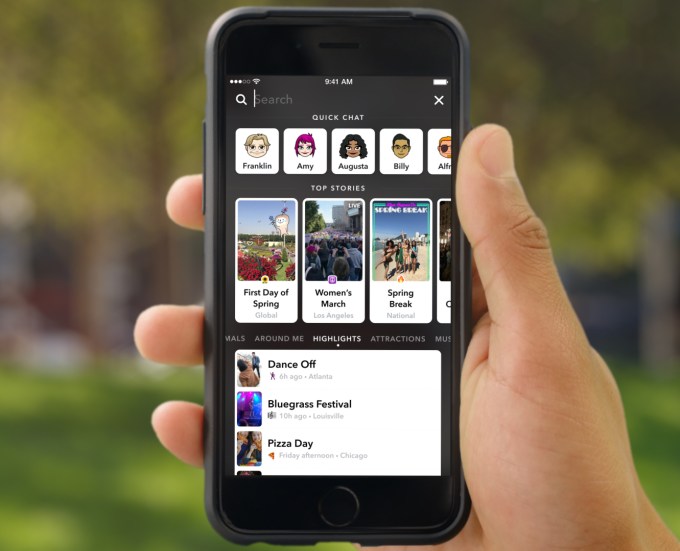
Snapchat is shifting from a social network limited to content shared by people you follow to an ephemeral, real-time database of what’s going on now everywhere. Today Snapchat launched Search for Stories submitted to its public Our Stories. It makes Snapchat as deep as whatever the world is sharing, creating near-infinite rabbit holes to go down, and a stronger competitor for YouTube and Twitter.


That aligns exactly with Snap IPO strategy following the slow-down of user growth after the removal of auto-advance and the launch of Instagram Stories and Facebook’s other competing clones: Snapchat wants to be where some people spend tons of engagement time, rather than where everyone spends a little time.


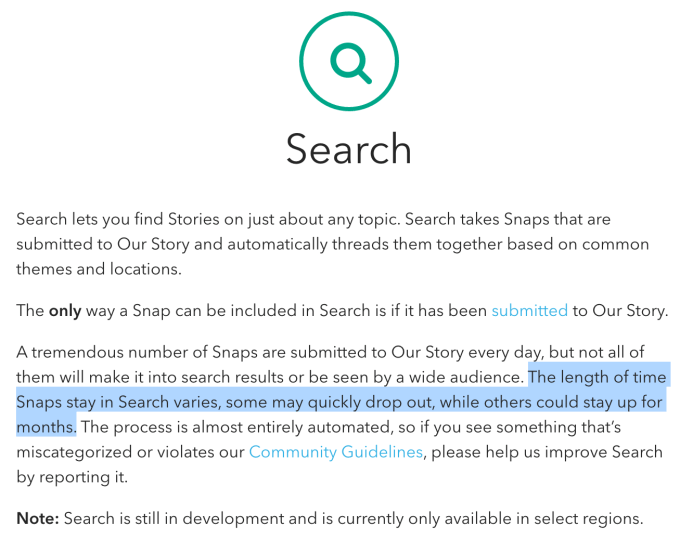
It also sees Snapchat break one of its cardinal rules. User-generated content is no longer limited to a lifespan of 24 hours. A Snapchat spokesperson confirms to TechCrunch that some Snaps submitted to Our Stories that appear in the new Search feature will be visible for less than a day to up to a few weeks or even months.


If content around a theme is being submitted more rapidly, what’s seen in Search results will turn over more quickly, while themes that only get submissions every few days may see Snaps stay visible for longer to make sure there’s something to watch for the theme.


[embedded content]


How Snapchat Stories Search works


In January, Snapchat opened the ability to submit to Our Story from people in certain locations, like big events, or at certain times, like Christmas, to everyone everywhere all the time. But this meant it was pulling in way more content than its human curators could package into specific, widely visible Our Stories like ones for the Macy’s Thanksgiving Day Parade or the NBA Finals.


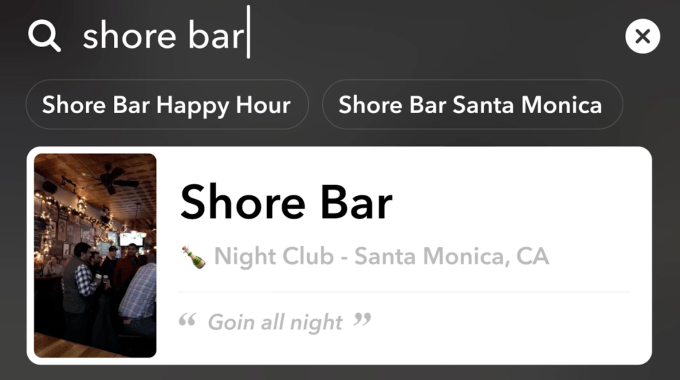
Now, Snapchat is using algorithms to scan the caption text, time and visual elements found in Snaps submitted to Our Story and group them by theme. For example, it could pull out Snaps with the words “dog” or “puppy” in captions, or use machine vision to detect the shape of a real dog in the photos or videos, and aggregate them into an Our Story that comes up when people search for “Puppies.” Snap notes you could use this to watch a nearby basketball game, see what’s happening at a local bar, check out a specific Fashion Week runway show or explore a vacation spot. More than 1 million themes will have Search results available.


Snap says it will keep expanding the ways it categorizes submissions. Perhaps that could eventually include what background music is playing or what voices are saying


The rollout of the feature begins with people in select U.S. cities being able to search for public Our Stories, but everyone’s submissions are already being indexed. For now, no ads, sponsored lenses or sponsored geofilters will appear in the Search collections. That makes this a play for more engagement, not a new channel to drive more ad views.


Snaps submitted to Our Story can appear in Search results for up to months, rather than disappearing after 24 hours like usual


Why Search makes Snapchat endless


Previously, you could think of Snapchat like a television with the Stories of people you follow as different cable channels. Discover and Snapchat Shows were like HBO, offering extra premium content. All you could watch was what these channels aired. If you flipped through all the channels and still weren’t satisfied, you were out of luck.


Search is like having the world’s biggest Blockbuster video rental spot open up next door. Suddenly you can browse a near-endless array of content in all sorts of categories, from popular mainstream releases to weird niche foreign films. New films arrive faster than you can watch them, so there’s always something you haven’t seen available.


For the biggest Snapchat fans, this uncaps their potential engagement time. You can now do around-the-clock movie marathons.


Another analogy is to think of Search as turning Snapchat into the ephemeral, real-time YouTube built for mobile video creation. YouTube indexes the world’s online recorded video content with Google’s search prowess. But often there’s a delay of a few hours to days from when something is recorded to when people upload it. And since YouTube was originally built for the web, the clips are typically longer, from 30 seconds to a few minutes.


That norm subtly discourages short-form, mobile-shot, real-time, off-the-cuff content. And that leaves the door open for Snapchat and its new search feature. Instead of just relying on text descriptions and manually added tags, Snapchat is using machine vision to see what’s actually in content, then categorize and index it. Since it’s all mobile and people submit to Our Story as soon as they’ve shot something, plus it’s curated mostly by algorithms, content should be more quickly searchable.


And because Snaps disappear eventually, even if not just after 24 hours here, it encourages the submission and searchability of raw, unpolished, but still compelling content YouTube isn’t getting.


Finally, you could also see Stories Search as a competitor to Twitter. If you want to read what people are saying around a topic in real time, today you search Twitter. But now if you want to SEE what people are capturing with their cameras around a topic in real time, you can search Snapchat. The camera is the new keyboard, after all.


These ideas support the narrative Snap has been pitching to investors. It can’t sell itself on future user growth and eventual massive scale like Facebook since its growth plummeted late last year around when Instagram Stories launched. Instead, while it only has 158 million daily active users, it repeatedly highlighted that they spend 25-30 minutes a day in Snapchat on average. Search thereby fuels Snapchat’s best hope for growth, not in breadth of users but in the depth of their engagement.


If Snap can’t get everyone on earth using it because Facebook’s slew of Stories competitors steal the international markets and older demographics, then Snap must get the U.S. teens it already has addicted to stick around longer. Search is how.

Twitter’s redesign raises the question: What came first, the troll or the egg?


The Twitter egg is a joke we never really got. The placeholder avatar for users without a profile photo was supposedly a reference to the bird on Twitter’s logo. “This was a playful way to reference how eggs hatch into birds that send all the Tweets you see on Twitter,” their design team explained. Get it? Neither did we.


After seven years, Twitter announced today that it’s finally ditching their flat design. Twitter’s design team explains in a March 31 blog post that they’re changing the default profile avatar because the egg has become a symbol of online trolling. “We’ve noticed patterns of behavior with accounts that are created only to harass others—often they don’t take the time to personalize their accounts. This has created an association between the default egg profile photo and negative behavior….”


Avatar-Blog1-Years
The evolution of Twitter’s default avatar. (Twitter)

Ars Technica‘s national security editor Sean Gallagher echoes Twitter’s observation. Surveying social media troll tactics, he writes:


“Egg” accounts—Twitter profiles that have the default “egg” avatar instead of a profile photo—are frequently associated with bots and throwaway accounts. But they’re also associated with people who just don’t post that often and may not know how (or care) to change their profile picture. A sure sign that there’s a normal user behind an egg is if geolocation data has been left turned on for the account.


In lieu of the tainted egg, the design team has come up with a generic head-and-shoulders “place photo here” symbol to make it clear to users that they should upload a unique image. The design team notes that they obsessed over creating a “gender-balanced” silhouette, tweaking the head shape (is that a woman with a bob or man with a wide jaw?) and the width of the figure’s shoulders.


(Twitter)

Twitter’s egg substitute mimics the head-and-shoulder placeholder graphics Facebook and LinkedIn are already using.


The avatar redesign is part of Twitter’s plan to combat the rise of online bullying. The platform has faced growing criticism for their lack of stronger action against president Donald Trump’s regular barrage of “bully tweets” and the militia of cyberbullies who routinely shame, stalk, and harass other Twitter users. In an effort to combat trolls and harassment, Twitter unveiled a new set of safety features in February, including preventing blocked users from creating new accounts and a notification filter flagging users with a default avatar.


Twitter’s live streaming app Periscope gets an analytics dashboard


Trying to figure out this whole live video broadcasting thing? Good news!


Periscope, the Twitter-owned live-broadcasting app, picked up a new trick this morning: a shiny new analytics dashboard.


It’s not the most groundbreaking thing in the world, but it makes sense. Making a successful live video on the internet — particularly one that doesn’t involve video games or naked people — is hard. It’s the reason why company after company in this space has failed: Most people just aren’t that interesting all the time.


Perhaps a bit of data on what works and what doesn’t is the key to cracking the code.


Periscope’s analytics dashboard will track video duration, number of viewers, hearts and time watched per viewer. Hopefully they can expand into providing data on a minute-per-minute basis tied to your stream’s replay so you can start to learn exactly where you’re losing people, but this is a solid start.


Meanwhile, Twitter also announced that Periscopes will now be viewable live within the company’s curated news stories, Moments, as the company continues to push into live video across the platform. Don’t count on having your story show up in a Moment — there’s a whole lot of serendipity required there (right place, right time and noticed by the curation team) — but when it works, it could be a good fit.

Twitter introduces pre-roll ads to Periscope videos


Twitter is announcing a new ad unit — pre-roll ads on Periscope videos.


In a blog post, Periscope Group Project Manager Mike Folgner says the ads will appear in a way that’s “organic to how people already consume that content on the platform.” Basically, publishers will have the option to run a short video ad that plays before you watch their Periscope videos (both live broadcasts and replays) on Twitter.


The company has already been rolling out ways for advertisers to create custom campaigns around live Periscope video, but a standard pre-roll ad should be the most straightforward option. That means it’ll probably be used by wider range of publishers, creators and advertisers than what we’ve seen so far.


“For creators and publishers that use Periscope to go live on Twitter every day, these pre-roll ads present a new way to monetize their video content,” Folgner writes. “For marketers, they have a new source of video advertising beyond what was previously available, including ads during live streaming programs, Promoted Tweets with Periscope video, and custom Amplify campaigns with live content  from influential creators.”


Twitter says it will be making Periscope pre-rolls broadly available to advertisers over the next few months.


This is a crucial time for Twitter’s ad business. Despite all the attention around the U.S. presidential campaign (and Donald Trump’s Twitter account) ad revenue seemed to stall at the end of 2016 — an issue that CEO Jack Dorsey addressed in the most recent earnings call, when he said, “2017 will be about simplifying and differentiating our revenue products.”

Twitter remembers it owns TweetDeck


It’s been six years since Twitter acquired TweetDeck, but the company might finally bring new features to the client.


In a survey sent to some power users today, Twitter asked which features they would most like to see added to an “advanced” version of TweetDeck. After that, respondents were asked if they’d be willing to pay for a more full-featured version of a client that otherwise has been mostly forgotten.


A brief history of TweetDeck neglect


Twitter acquired TweetDeck for $40 million back in 2011, at a time that was particularly fraught for developers building mobile and desktop clients that competed with Twitter’s own. Just two months earlier, Twitter’s then-head of platform Ryan Sarver had warned developers to stop making Twitter clients and focus instead on complementary apps and services.


In that respect, TweetDeck being bought was probably preferable to having its API access shut off and dying a slow death. But those who hoped TweetDeck would be the basis for a more robust Twitter client for power users would end up being sorely disappointed.


While Twitter never officially killed off TweetDeck, the product has languished from lack of development over the last several years. It got a small update in late 2012, but since then has seen features slowly disappear or fail to keep pace with features that were added to Twitter’s official clients. First mobile TweetDeck clients disappeared, and later the native Windows client was discontinued.


Still, despite lack of internal support, TweetDeck maintains a fairly passionate user base on the Web and its Mac desktop app. And, like the phoenix rising from its ashes, Twitter is threatening to make the client a paid subscription client for power users.


Ranking valuable features


TweetDeck users who participated in the survey were asked which features they might find most helpful if added to the client. That includes things like advanced charts, follower analytics, breaking news alerts, mobile and desktop management, ability to change the color scheme and multiple account switching.


Survey respondents were also asked how much or how little they would pay for the client. While Andrew Tavani, who publicly shared his questions from the survey, was asked if he would pay $19.99 monthly, TechCrunch director of audience development Travis Bernard was asked if he would pay $4.99 for a premium version of the app. It’s likely that Twitter is testing various prices to see how users respond.


Some view the survey as a sign Twitter is considering developing a new revenue stream beyond advertising, which has started to lag in recent quarters. But Twitter says that isn’t the case.


After news of the survey got out, Twitter issued the following statement on its plans:


“We’re conducting this survey to assess the interest in a new, more enhanced version of TweetdDeck. We regularly conduct user research to gather feedback about people’s Twitter experience and to better inform our product investment decisions, and we’re exploring several ways to make TweetDeck even more valuable for professionals.”


Featured Image: Justin Sullivan/Getty Images

Social media firms facing fresh political pressure after London terror attack


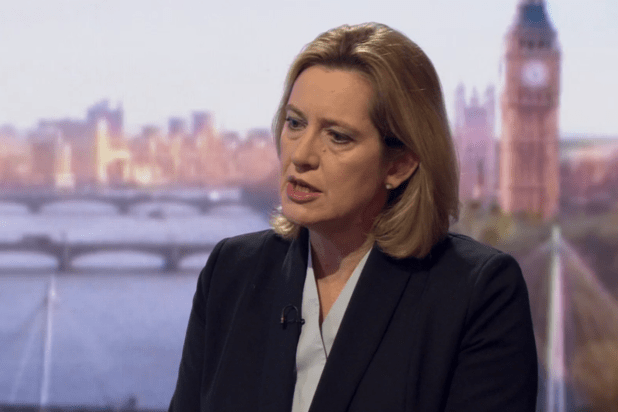
Yesterday UK government ministers once again called for social media companies to do more to combat terrorism. “There should be no place for terrorists to hide,” said Home Secretary Amber Rudd, speaking on the BBC’s Andrew Marr program.


Rudd’s comments followed the terrorist attack In London last week, in which lone attacker Khalid Masood drove a car into pedestrians walking over Westminster bridge before stabbing a policeman to death outside parliament.


Press reports of the police investigation have suggested Masood used the WhatsApp messaging app minutes before commencing the attack last Wednesday.


“We need to make sure that organisations like WhatsApp, and there are plenty of others like that, don’t provide a secret place for terrorists to communicate with each other,” Rudd told Marr. “It used to be that people would steam open envelopes or just listen in on phones when they wanted to find out what people were doing, legally, through warranty.


“But on this situation we need to make sure that our intelligence services have the ability to get into situations like encrypted WhatsApp.”


Rudd’s comments echo an earlier statement, made in January 2015, by then Prime Minister David Cameron, who argued there should not be any means of communication that “in extremis” cannot be read by the intelligence agencies.


Cameron’s comments followed the January 2015 terror attacks in Paris in which islamic extremist gunmen killed staff of the Charlie Hebdo satirical magazine and shoppers at a Jewish supermarket.


Safe to say, it’s become standard procedure for politicians to point the finger of blame at technology companies when a terror attack occurs — most obviously as this allows governments to spread the blame for counterterrorism failures.


Facebook, for instance, was criticized after a 2014 report by the UK Intelligence and Security Committee into the 2013 killing of solider Lee Rigby by two extremists who had very much been on the intelligence services’ radar. Yet the parliamentary ISC concluded the only “decisive” possibility for preventing the attack required the Internet company to have pro-actively identified and reported the threat — a suggestion that effectively outsources responsibility for counterterrorism to the commercial sector.


Writing in a national newspaper yesterday Rudd also called for social media companies to do more to tackle terrorism online“We need the help of social media ­companies: the Googles, the Twitters, the Facebooks, of this world,” she wrote. “And the smaller ones, too — ­platforms like Telegram, WordPress and Justpaste.it.”


Rudd also said Google, Facebook and Twitter had been summoned to a meeting to discuss action over extremism, as well as suggesting the government is considering including new proposals to make Internet giants take down hate videos quicker in a forthcoming counterterrorism strategy — which would appear to mirror a push in Germany. The government there proposed a new law earlier this month to require social media firms to remove illegal hate speech faster.


So, whatever else it is, a terror attack is a politically opportune moment for governments to apply massively visible public pressure onto a sector known for engineering workarounds to extant regulation — as a power play to try to eke out greater cooperation going forward.


And US tech platform giants have long been under the public counterterrorism cosh in the UK — with the then head of intelligence agency GCHQ arguing, back in 2014, that their platforms had become the “command-and-control networks of choice for terrorists and criminals”, and calling for “a new deal between democratic governments and the technology companies in the area of protecting our citizens”.


“They cannot get away with saying… “


As is typically the case when governments talk about encryption, Rudd’s comments to Marr are contradictory — so on the one hand she’s making the apparently timeless call for tech firms to break encryption and backdoor their services. Yet when pressed on the specifics she also appears to claim she’s not calling for that at all, telling Marr: “We don’t want to open up, we don’t want to go into the cloud and do all sorts of things like that, but we do want [technology companies] to recognise that they have a responsibility to engage with government, to engage with law enforcement agencies when there is a terrorist situation.


“We would do it all through the carefully thought through, legally covered arrangements. But they cannot get away with saying ‘we are in a different situation’ — they are not.”


So, really, the core of her demand is closer co-operation between tech firms and government. And the not so subtle subtext is: ‘we’d prefer you didn’t use end-to-end encryption by default’.


After all, what better way to workaround e2e encryption than to pressurize companies not to pro-actively push its use in the first place… (So even if one potential target’s messages are robustly encrypted, the agencies could hope to find one of their contacts whose messages are still accessible.)


A key factor informing this political power play is undoubtedly the huge popularity of some of the technology services being targeted. Messaging app WhatApp has more than a billion active users, for example.


Banning popular tech services would not only likely be technically futile, but any attempt to outlaw mainstream networks would be tantamount to political suicide — hence governments feeling the need to wage a hearts and minds PR war every time there’s another terrorist outrage. The mission is to try to put tech firms on the back foot by turning public opinion against them. (Oftentimes, a goal aided and abetted by sections of the mainstream UK media, it must be said.)


In recent years, some tech companies with very large user-bases have also been shown to make high profile stances championing user privacy — which inexorable sets them on a collision course with governments’ national security priorities.


Consider how Apple and WhatsApp have recently challenged law enforcement authorities’ demands to weaken their security system and/or access encrypted data, for instance.


Apple most visibly in the case of the San Bernardino terrorist’s locked iPhone — where the Cupertino company resisted a demand by the FBI that it write a new version of its OS to weaken the security of the device so it could be unlocked. (In the event, the FBI paid a third party organization for a hacking tool that apparently enabled it to unlock the device.)


While WhatsApp — aside from the fact the messaging giant has rolled out end-to-end encryption across its entire platform, thereby vastly lowering the barrier to entry to the tech for mainstream consumers — has continued resisting police demands for encrypted data, such as in Brazil, where the service has been blocked several times as a result, on judges’ orders.


Meanwhile, in the UK, the legislative push in recent years has been to expand the investigatory capabilities of domestic intelligence agencies — with counterterrorism the broad-brush justification for this push to normalize mass surveillance.


The current government rubberstamped the hugely controversial Investigatory Powers Act at the back end of last year — which puts intrusive powers that had been used previously, without necessary being avowed to parliament and authorized via an antiquated legislative patchwork, on a firmer legal footing — including cementing a series of so-called “bulk” (i.e. non-targeted) powers at the heart of the UK surveillance state, such as the ability to hack into multiple devices/services under a single warrant.


So the really big irony of Rudd’s comments is that the government has already afforded itself swingeing investigatory powers — even including the ability to require companies to decrypt data, limit the use of end-to-end encryption and backdoor services on warranted request. (And that before you even consider how much intel can profitably be gleaned by intelligence agencies looking at metadata — which end-to-end encryption does not lock behind an impenetrable wall.)


Which begs the question why Rudd is seemingly asking tech companies for something her government has already legislated to be able to demand.


” …stop this stuff even being put up”


Part of this might be down to intelligence agencies being worried that it’s getting harder (and/or more resource intensive) for them to prioritize subjects of interest because the more widespread use of end-to-end encryption means they can’t as easily access and read messages of potential suspects. Instead they might have to directly hack an individual’s device, for instance, which they have legal powers to do should they obtain the necessary warrant.


And it’s undoubtedly true that agencies’ use of bulk collection methods means they are systematically amassing more and more data which needs to be sifted through to identify possible targets.


So the UK government might be testing the water to make a fresh case on the agencies’ behalf — to push for quashing the rise of e2e encryption. (And it’s clear that at least some sections of the Conservative party do not have the faintest idea of how encryption works.) But, well, good luck with that!


Either way, this is certainly a PR war. And — perhaps most likely — one in which the UK government is jockeying for position to slap social media companies with additional extremist-countering measures, as Rudd has hinted are in the works.


Something that, while controversial, is likely to be less so than trying to ban certain popular apps outright, or forcibly outlaw the use of end-to-end encryption.


On taking action against extremist content online, Rudd told Marr the best people to solve the problem are those “who understand the technology, who understand the necessary hashtags to stop this stuff even being put up”. Which suggests the government is considering asking for more pre-emptive screening and blocking of content. Ergo, some form of keyword censoring.


One possible scenario might be that when a user tries to post a tweet containing a blacklisted keyword they are blocked from doing so until the offending keyword is removed.


Security researcher, and former Facebook employee, Alec Muffett wasted no time branding this hashtag concept “chilling” censorship…


But mainstream users might well be a lot more supportive of proactive and visible action to try to suppress the spread of extremist material online (however misguided such an approach might be). The fact Rudd is even talking in these terms suggests the government thinks it’s a PR battle they could win.


We reached out to Google, Facebook and Twitter to ask for a response to Rudd’s comments. Google declined to comment, and Twitter had not responded to our questions at the time of writing.


Facebook provided a WhatsApp statement, in which a spokesperson said the company is “horrified by the attack carried out in London earlier this week and are cooperating with law enforcement as they continue their investigations”. But did not immediately provide a Facebook-specific response to being summoned by the UK government for discussions about tackling online extremism.


The company has recently been facing renewed criticism in the UK for how it handles complaints relating to child safety. As well as ongoing concerns in multiple countries about how fake news spreads across its platform. On the latter issue, it’s been working with third party fact checking organizations to flag disputed content in certain regions. While on the issue of illegal hate speech in Germany Facebook has said it is increasing the number of people working on reviewing content in the country, and claims to be “committed to working with the government and our partners to address this societal issue”.


It seems highly likely the social media giant will soon have a fresh set of political demands on its plate. And that ‘humanitarian manifesto‘ Facebook CEO Mark Zuckerberg penned in February, in which he publicly grappled with some of the societal concerns the platform is sparking, is already looking in need of an update.