Showing posts with label Startups. Show all posts

Blackstorm Labs and Rakuten launch R Games to build high-fidelity HTML5 games
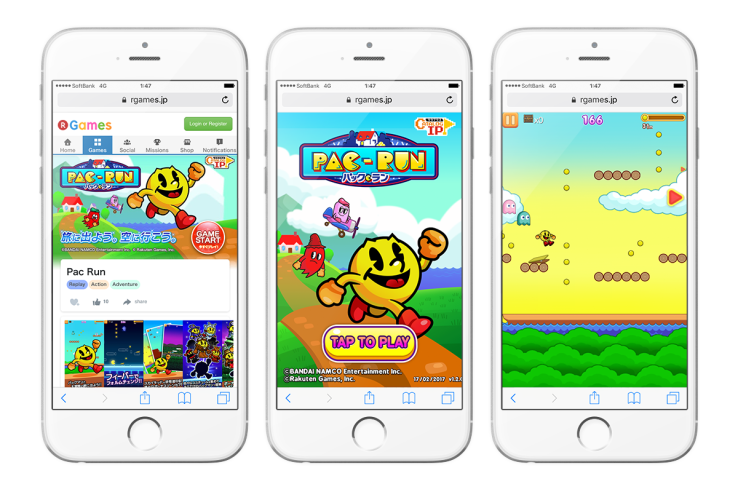


Blackstorm Labs, a startup that’s working to build technology that brings developers tools to get out games and apps more quickly through HTML5, today said it is working with Rakuten to build a new entity called R Games that will serve as a hub for games in Japan and Asia.


Blackstorm Labs has been working with Rakuten for some time on the project, which was rumored last November, but it is coming out officially this evening, and co-founder Ernestine Fu said that working with Rakuten dovetails with users in Asia generally having a more progressive worldview of app distribution. Apps running on Blackstorm Labs’ technology are designed to boot instantly and have the same quality of a regular app without having to download large files.


“If you think about any new distribution platform you try to create, you need to have premiere amazing content on that platform,” Fu said. “The game studio to feed some initial content. But at some point we’ll open to additional developers.”


R Games is more of a “joint spinout,” with Blackstorm basically handling education and development of the technology and relaying that over to Rakuten. R Games already has dozens of people working on games that will be distributed through Blackstorm Labs’ HTML5 technology, and is tapping big brands like Taito to make games like Bubble Bobble and Pac-Man. The startup has one board seat in the venture.


Blackstorm Labs isn’t actually shipping any of its existing employees off to R Games, which would certainly not be a scalable situation if it were to seek additional partnerships and deals like these. But late last year, it became clear that the technology had a opportunity to create, at the very least, a thriving gaming ecosystem based around HTML5 technology, Fu said.


“We built within two days this quick bubble shooter game — it was not polished at all,” Fu said. “We were able to take that game and show it to the folks at Rakuten. It was all these things that were rough but it was one of those big moments that there are new distribution platforms. At the time HTML5 tech was so rapidly changing, Google and Apple were a part of that,”


Games still continues to be one of the strongest showcases of the technology, with the ability to quickly dive into a high-fidelity gaming experience that can tap into more social elements across different platforms like Facebook Messenger. But Blackstorm Labs’ technology can theoretically go beyond games, if developers are able to use that technology to figure out new use cases for applications that can quickly spin up and launch within a browser while having the same level of quality of a downloaded app.


If that’s the case — and that was one of the core elements of Blackstorm Labs’ pitch — then developers may be able to sidestep the cluttered App Store completely if it gets wide adoption. The actual applications could theoretically be embedded within links in your News Feed or messenger clients while still behaving like a typical app. Getting that technology widely adopted is still going to be an uphill battle, but part of the reason the company started off with games is that they have very high performance requirements.

Nuzzel launches a ‘Newswire’ for sponsored content


For the first time, news aggregator Nuzzel will include advertising.


That doesn’t mean you’re going to see banner ads popping up all over the startup’s app and website. Instead, the Nuzzel Newswire consists of sponsored links in Nuzzel’s email newsletter, pointing to a blog post, press release or news article of the advertiser’s choosing.


So why call it a “newswire” when it’s really just sponsored content? Nuzzel founder and CEO Jonathan Abrams told me he’s pitching this as an alternative to paying for press release distribution through a service like PR Newswire, where he said “probably few people will really read” it.


“Of course you could do both,” Abrams said. “But the idea is that this is a way to get your content in front of influencers that a traditional press release service may not deliver, since they take anything and release so many press releases every day.”


In contrast, he said the Newswire will only run one sponsored story per day.


Nuzzel promoted story


Nuzzel, for those of you who haven’t tried it, offers a number of ways to keep track of the news, whether that’s following feeds/newsletters curated by Nuzzel or other users, or by connecting your Twitter account to see the stories that are getting the most shares from the people you follow.


Abrams declined to reveal anything about the size of Nuzzel’s audience, except that “it’s fair to say that at this point, the real value of the Nuzzel Newswire is the quality of the audience vs. huge size” — a point underlined on the Newswire website, which highlights a few individual Nuzzel users.


As for why the ads are only running in the newsletters, Abrams said he might add them to other products in the future, but he’s starting with email “because we thought native ads in email newsletters would get really good engagement and not as many people were doing it.”

Scheduled is a new app that lets you schedule your text messages


Want to remember to tell a friend happy birthday, good luck or congratulations? Had a follow-up question for a client that just occurred to you at 1 AM? Want to write a heartfelt thank you to be texted at a later date? Unfortunately, neither SMS nor most messaging apps – including iMessage – allow you to draft a text in advance and schedule it to be sent out on a later date. But a new iOS application called Scheduled can help.


To be clear, the app does not actually schedule texts for automatic sending.


For that, you’d need to hack your iPhone and use one of the jailbreak apps instead. Apple does not allow for this functionality, officially.


What Scheduled does is offer an App Store-approved workaround for scheduling texts.


The app itself is simple and straightforward to use.


You first select the person you want to text from your Contacts, then write the text you want to send and select the time you want to be reminded to send the text. When that time rolls around, Scheduled sends you a push notification so you can return to the app to send the text.


After sending, a quick swipe will delete the reminder from the app’s queue.


Scheduled isn’t only for SMS or iMessage, however – it also supports messaging apps like Telegram, WhatsApp, Messenger, Twitter, and it allows you to copy the message’s text to paste it into any other app of your choice. It can be used for reminding you of emails or phone calls, too.


Further down the road, Scheduled plans to add support for LinkedIn and Slack, and it will roll out a few tweaks to the sending flow, Apple Watch integration, and Android support at some point.


To be fair, there are other text message scheduling apps on the App Store, but Scheduled’s interface is clean and modern, compared with those I’ve seen previously.


  1. compose message – text – en@1x


  2. overview – text – en@1x


  3. send with – text -en@1x


The app itself is a product from Brthrs Agency, a digital agency just outside Amsterdam in The Netherlands, which does a combination of client work and startup investing.  The team, which consists of Sebastiaan Kooijman and Robert Keus, tells TechCrunch that Scheduled is currently a bootstrapped company project. They’re considering making it a startup of its own, if it achieves traction.


The team says the plan to make money is to charge $0.99 if you want to add four or more messages to the queue.


Of course, many users are already asking for auto-send functionality following the app’s launch a few days ago, but this is not something that Apple permits.


“We are investigating the options [for auto-send],” says Keus, “but it’s hard from a technical perspective. And our concept is to support people to be thoughtful,” he adds. “When we have auto-send then people can act like robots.”


Agreed.


Scheduled is currently a free download on the iTunes App Store. 

Moodelizer helps add epic soundtracks to your video efforts


When it comes to video, the audio is pretty damn important. Hell, they even give out some sort of award for getting it right on occasion. Moodelizer wants to put the power of suitable soundtracks in the hands of amateur filmmakers, by letting you add a delightfully over-the-top soundtrack to the most mundane of tasks at the touch of a button.


Moodelizer has created a ton of different music tracks, with a twist: They come unmixed, and with an elegant set of mixing tools to help even non-musicians create great-sounding soundtracks for video.


So you may have a nice bit of calm music leading up to a snowboard stunt, for example. When the sportsperson turns the hella nar nar to 11, you can add some funky beats and heavy orchestrations to turn the drama up. It sounds really simple, because, well, it is. But the app works incredibly well — and a piece of music that’s finely tuned to the film you’re showing off goes a long way to making the viewer’s heart rate peak at just the right times.


Turn the sound as loud it goes, and check this out to get a feeling for what the company’s trying to do:


And, in a similar vein, but showing off the idea of building the drama in music just a tiny bit better, this one makes me happy, too:


To demo its tech, the company has released an app, now available on iOS, with an Android version coming in a month or so. Of course, all of this is probably mostly a stunt to sell more licenses of its professional Moodelizer Studio product, but who cares: The app is free and tons of fun. Definitely one to play around with for an afternoon, if nothing else.

Aiden closes $750,000 seed round in its quest to amplify marketers


Aiden, a London-based startup building a machine learning-powered personal assistant to save mobile marketers time and money, closed a $750,000 seed round today from Kima Ventures and a number of angels, including Nicolas PintoPierre Valade and Jonathan Wolf. The team first demoed the capabilities of its service on the stage of TechCrunch Disrupt as a Battlefield finalist. 


In recent years, marketers have begun to suffer information paralysis from the flood of new monitoring platforms on the market. Rather than create an entirely new end-to-end solution, Aiden merely wants to help marketers get at the data they need faster.


The Aiden conversational assistant aims to make querying for key performance metrics as easy as checking the weather on Amazon Alexa. From a technical perspective, the team is focusing their efforts in two places — natural language processing and expert systems.


The natural language processing work is intuitive; 90 percent of the challenge in building a system like Aiden is deriving the intent of any given user query. The time spent on NLP helps Aiden respond appropriately, no matter how a question is phrased.


The emphasis on expert systems, on the other hand, is a bit less textbook. Expert systems have been around in some form or another since the 1970s. The idea is that humans can encode their knowledge into computers that can later be recalled — creating the illusion of intelligence. But while most consider them to be out of date, expert systems embody the present ethos of human and machine collaboration.


Aiden co-founders Marie Outtier and Pierre-Jean Camillieri


Marie Outtier, co-founder of Aiden, is a marketer by trade. Her co-founder, Pierre-Jean Camillieri, built Aiden around Outtier’s knowledge of the industry. Because Aiden possesses baseline expectations for key performance indicators, it can proactively alert marketers when something seems out of balance.


When the company comes out of beta, it plans to target businesses with relatively high mobile marketing ad-spend — this tends to include a lot of startups. If it can straddle enough of the long-tail of marketing anomalies, this should allow companies to identify mismatches in ad-spend more quickly to more efficiently allocate limited resources.

Tinder Online is a new web version of the dating app


Tinder is today introducing a new way for users to access the platform with the launch of Tinder Online, a web-optimized version of the dating app so people can Tinder at their desktops.


Tinder Online still requires that you sign on to your account through Facebook, and it doesn’t include any of Tinder’s revenue features like Tinder Boost or Super Like, for now.


Head of Product at Tinder, Brian Norgard, says that Tinder Online is meant to serve users in emerging markets who don’t have enough storage on their phone (the app is 128MB on iOS) or a big enough data plan for Tinder’s image-heavy feed. It’s also meant to offer Tinder power users the option to do their swiping and messaging on desktop, which is far easier on power users than a mobile app.


And, according to the blog post, Tinder Online is meant to serve users who are tied up at their computer, either in class or at work, and want to switch between Tinder tabs and actual productivity.


Introducing Tinder Online: a fun, new web experience and your English professor’s worst nightmare. Mobile phones not allowed in class? Just fire up your laptop and swipe incognito. Cubicle life got you down? Now you can toggle between spreadsheets and Super Likes in a flash. “Not Enough Storage?” Not a problem. Don’t let life get in the way of your Tinder game.


While the branding message of Tindering during class or work is questionable, the product itself makes a lot of sense.


Tinder has always been a native mobile app, first on iOS and then on Android. But the company now serves 196 countries across the world, and is learning to be flexible when it comes to giving people options about how they use Tinder.


As far as privacy is concerned, Tinder says that the only information it collects about users who log on to Tinder Online is location via the browser. Remember, Tinder uses Facebook as a log-in mechanism, so there is no shortage of personal information to which the company has access for the purposes of matching, marketing, or advertising. Browser history simply isn’t necessary.


“Our DNA is mobile so there was a learning curve involved in building something for a bigger screen,” said Norgard. “It was a challenge because when you start your birth as a mobile company, building for the web feels like you’re going backwards. There is a different skill set from a design perspective and a user behavior perspective. What makes Tinder great on your phone might not make it great on the desktop, and vice versa.”


From a philosophical standpoint, Tinder can feel to some users like more of a game than a social dating app. The company has made minor tweaks to counter this. The Tinder app used to say “Keep Playing!” after a match in big letters, prioritized over “Send Message.” Now, “Send Message” is prioritized over “Keep Swiping!”


On a broader scale, Tinder is built to be used as a time-sink just as much, if not moreso, than as a dating app that helps you connect with potential mates.


Making it accessible via web, and encouraging users to ignore class or work and Tinder instead, doesn’t necessarily make the app any more focused on the goal of connecting people, but rather getting as many swipes and matches as possible.


From a business perspective, Tinder fuels itself on user growth, with the hopes that those users convert into paid users, either subscribing to Tinder Plus or purchasing add-ons like Tinder Boost. Allowing users to access the platform from anywhere with an internet connection, without having to install any software, lowers the barrier to entry.


The launch of Tinder Online comes on the heels of news that Tinder was running a secret, members-only version of the app called Tinder Select, which lets invite-only users toggle between ‘celeb’ Tinder and regular-person Tinder. You can read more about Tinder Select here.


Tinder is currently testing Tinder Online in Argentina, Brazil, Colombia, Indonesia, Italy, Mexico, Philippines, and Sweden, with plans to launch everywhere ‘soon’.

Post Intelligence says it can make your tweets better


Social media can be hard.


I’m not speaking hypothetically here. There have definitely been days where I’ve thought, Shoot, it’s been way too long since I’ve posted on Instagram or Twitter — and then completely failed to post anyway because I had nothing to say. Maybe I would’ve done better if I’d used Post Intelligence.


I’ve seen plenty of other social media dashboards and assistants, but Post Intelligence’s assistant, which it calls Pi, offers the most direct advice that I’ve seen. After you connect your Twitter account or Facebook page, it creates a stream of links that you could consider posting. (Today, its first few suggestions for me were about Batman and Trump, which sounds about right.)


Once you’ve drafted a post, Pi will predict how well your post will do, and it might suggest what time to schedule it. It also offers analytics to see how a post did, and there’s even a marketplace to make money through sponsored posts.


Post Intelligence co-founder and CEO Bindu Reddy told me the product examines engagement data from Facebook and Twitter. Then it uses artificial intelligence to surface the topics that will do well with your followers, and to predict the performance of a post based on things like topic, length, sentiment and keywords.


“We’re making your tweets better,” Reddy said.


Post Intelligence


She emphasized that Pi isn’t actually telling users exactly what to say, and it’s not just focusing on whatever is currently the most popular — after all, sharing the exact same thing as everyone else isn’t necessarily a recipe for success.


“Instead of just these top five TV shows or 10 top news articles, we might highlight 1,000 different things,” Reddy said. “So I’m actually very positive that it gets rid of that echo chamber that we have.”


Post Intelligence was created by the same company behind social advertising platform MyLikes. Reddy said the technology is “completely new — we rewrote the whole infrastructure” and that the team is now focused solely on Post Intelligence.


The current version of Post Intelligence is available for free.